Lenovo has confirmed that the ThinkBook Plus Gen 7 Auto Twist is no longer a concept or show-floor experiment. The motorised, self-adjusting laptop is officially headed to market, with a commercial launch planned for June 2026 in the US.
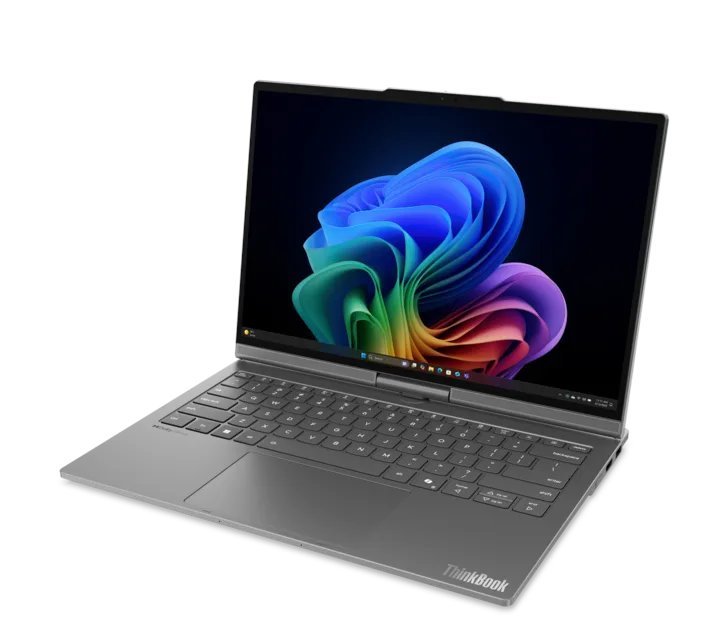
This device stands out not because of raw specs alone, but because of a mechanical feature rarely seen in modern laptops: a motorised hinge system that physically moves the display on its own.
This device stands out not because of raw specs alone, but because of a mechanical feature rarely seen in modern laptops: a motorised hinge system that physically moves the display on its own.
Auto-Twist Display: What Makes It Different
The defining feature of the ThinkBook Plus Gen 7 Auto Twist is its motor-powered OLED display mechanism.
Key behaviour enabled by the hinge system:
- The screen can rotate and tilt automatically
- Orientation changes happen without manual input
- The display can reposition itself based on how you’re seated
- It can shift into a tablet-style layout on its own
- Touch input is not required to trigger movement
This design targets scenarios like video calls, desk work, and presentations, where viewing angles matter and constant adjustment becomes annoying over time.
Display Specifications
Despite the added mechanics, Lenovo hasn’t compromised on panel quality.
Display details include:
- 14-inch OLED touchscreen
- 2.8K resolution
- 120Hz refresh rate
- Optimised for both productivity and media use
The combination of OLED visuals and high refresh rate positions the laptop well for creators, professionals, and multitaskers.
Core Hardware and Performance
Under the hood, Lenovo is pairing the unique display with next-generation internals.
Confirmed hardware highlights:
- Intel Panther Lake Core Ultra 300 series processors
- Up to 32GB DDR5-9600 RAM
- Up to 2TB PCIe Gen 4 SSD storage
- Large 75Wh battery, notable given the motorised hinge
The battery capacity suggests Lenovo has accounted for the extra power draw caused by the moving display components.
Ports, Connectivity, and Extras
Despite the complex hinge design, port selection remains practical.
Included I/O and connectivity:
- Two Thunderbolt 4 ports
- Two USB-A ports
- HDMI 2.1
- 3.5mm headphone jack
- Wi-Fi 7
- Bluetooth 5.4
Other notable additions:
- 10MP IR webcam with Windows Hello support
- Quad speakers
- Quad microphones
- Optimised for video conferencing and remote work
Ports, Connectivity, and Extras
Despite the complex hinge design, port selection remains practical.
Included I/O and connectivity:
- Two Thunderbolt 4 ports
- Two USB-A ports
- HDMI 2.1
- 3.5mm headphone jack
- Wi-Fi 7
- Bluetooth 5.4
Other notable additions:
- 10MP IR webcam with Windows Hello support
- Quad speakers
- Quad microphones
- Optimised for video conferencing and remote work
Design, Weight, and Build
Mechanical complexity often means bulk, but Lenovo has kept things relatively slim.
Physical details:
- Weight: 1.4kg
- Designed to remain portable despite the motorised system
- Built for daily professional use rather than experimental showcase appeal
This balance between innovation and portability is what separates the Auto Twist from earlier rotating-display attempts.
Why This Laptop Matters
The ThinkBook Plus Gen 7 Auto Twist signals a shift in how manufacturers think about laptop ergonomics.
Instead of asking users to adapt to fixed hardware, Lenovo is experimenting with hardware that adapts to the user.
If executed well, this could influence future designs beyond niche categories.
Leave a Reply