Samsung’s next-generation mobile chipset may already be quietly testing in the wild. An early Geekbench listing has revealed what appears to be the Exynos 2700, giving the first real look at its CPU layout, GPU pairing, and software environment. While this looks like an engineering reference device, the details offer meaningful clues about Samsung’s silicon direction for 2026.
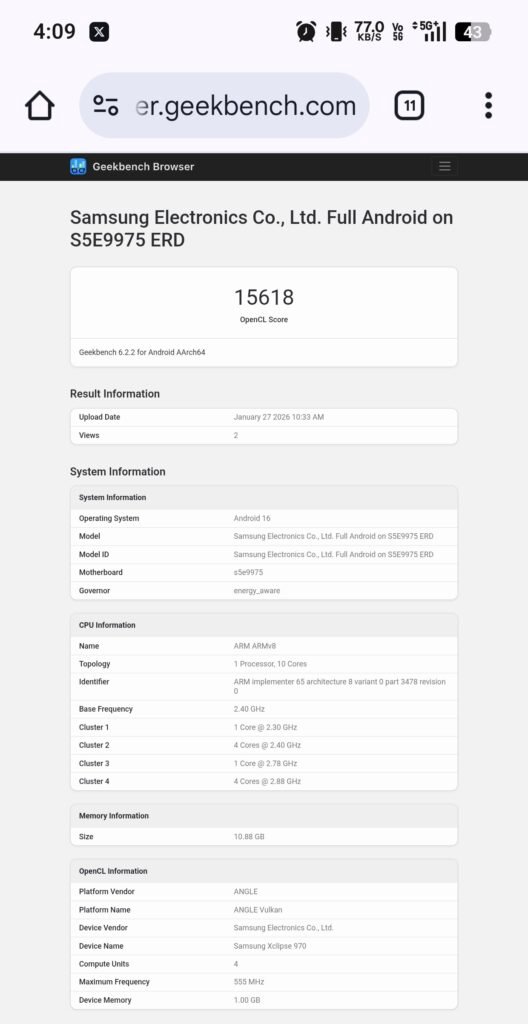
This is not a launch confirmation, but early benchmark sightings often signal that internal testing has moved beyond the lab stage.
What showed up on Geekbench:
- Chipset name: Exynos 2700
- Internal reference: S5E9975 ERD
- Manufacturer: Samsung Electronics Co., Ltd.
- Operating system: Android 16
- Memory configuration: 12GB RAM
- Test type: Full Android build
The presence of Android 16 strongly suggests this silicon is being tested for next-generation Galaxy devices rather than current models.
CPU configuration details (Deca-core layout):
- Total cores: 10
- Core clusters appear split across four frequency groups
Observed CPU clusters:
- 1 performance core clocked at 2.30GHz
- 4 efficiency-focused cores at 2.40GHz
- 1 higher-performance core at 2.78GHz
- 4 top-tier cores clocked at 2.88GHz
This unusual four-cluster, ten-core design hints at a refined balance strategy rather than brute-force performance scaling.
What this CPU layout suggests:
- Better workload distribution across light, medium, and heavy tasks
- Improved thermal management under sustained loads
- More granular power scaling for gaming, camera, and background tasks
- A focus on consistency rather than short benchmark spikes
Samsung appears to be moving further away from traditional big-little layouts and toward more flexible CPU scheduling.
GPU details from the benchmark:
- GPU name: Samsung Xclipse 970
- Architecture: AMD RDNA-based (expected continuation of Xclipse lineup)
- Geekbench OpenCL score: 15,618
This GPU score places the chip firmly in upper mid-range to flagship-adjacent territory, depending on final clocks and drivers.
Why the GPU result matters:
- Indicates early graphics driver stability
- Confirms Samsung’s continued partnership with AMD graphics IP
- Suggests meaningful gains over previous Exynos generations
- Shows potential for improved gaming and compute workloads
Keep in mind, early OpenCL scores rarely reflect final performance. Optimisations usually arrive much later.
Why this leak is important for users:
- Confirms Exynos 2700 development is well underway
- Signals Samsung’s commitment to custom silicon despite past criticism
- Offers early insight into Galaxy device performance expectations
- Helps developers prepare for upcoming architecture changes
For users, this matters because silicon decisions directly impact battery life, camera processing, AI features, and long-term software support.
What’s still unknown:
- Final CPU core types (exact ARM designs not confirmed yet)
- GPU clock speeds and ray-tracing capabilities
- AI/NPU performance and on-device generative features
- Whether this chip targets Galaxy S-series, FE models, or regional variants
Samsung typically refines clocks and thermals significantly before mass production.
What to expect next:
- More benchmark sightings with different RAM configurations
- Vulkan and AI benchmark results
- Power efficiency data from sustained tests
- Clarity on which Galaxy devices will use Exynos 2700
If history is any indication, more leaks will surface well before an official announcement.
For now, the Exynos 2700 looks like a serious internal reboot rather than a minor iteration. While it’s too early to judge real-world performance, this first Geekbench appearance confirms that Samsung’s next silicon cycle has officially begun.
Leave a Reply