Google has introduced a new research-focused AI tool called PaperBanana, designed to generate publication-ready academic illustrations directly from methodology text.
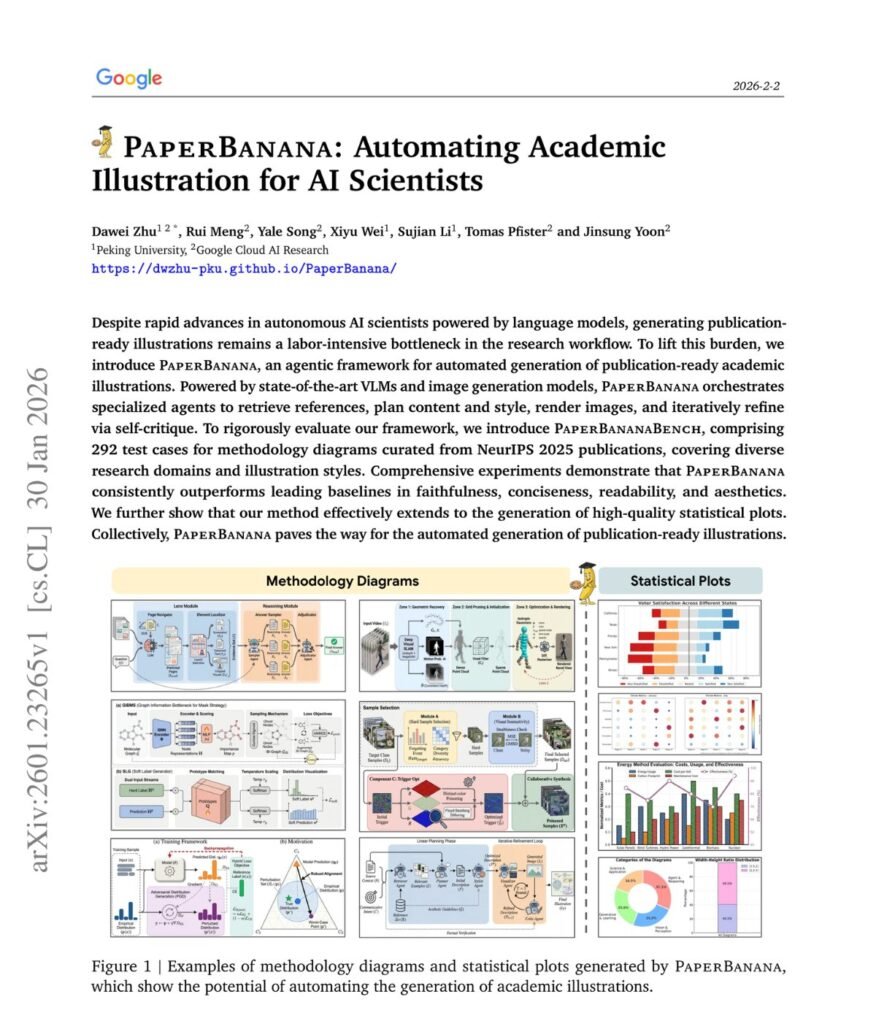
The idea is simple but powerful. Instead of manually creating diagrams in design tools or struggling to visualize complex methods, researchers can now describe their approach in text and let AI handle the visuals.
PaperBanana targets one of the most time-consuming parts of academic work: creating clear, standardized figures that meet journal-quality expectations.
What PaperBanana Does
PaperBanana converts plain methodology descriptions into structured academic diagrams.
Key capabilities include:
- Generates publication-ready figures from text input
- Designed specifically for academic and research use
- No design software required
- No illustration or layout skills needed
- Output aligns with common research paper standards
This makes it useful for researchers, PhD students, and academics who want clarity without spending hours on visual formatting.
How the System Works Behind the Scenes
PaperBanana isn’t a single model doing everything. It uses a coordinated pipeline of AI agents, each handling a specific task.
The workflow looks like this:
- One agent searches for strong diagram examples
- One agent plans the structural layout
- One agent defines visual styling and spacing
- One agent generates the actual illustration
- One agent reviews the output and refines it
This multi-agent setup allows the system to reason visually instead of just drawing shapes.
The result is diagrams that feel intentional, balanced, and readable rather than auto-generated.
Why Reference Examples Matter More Than Topic Matching
One of the most interesting findings from PaperBanana’s development is how reference examples are used.
According to internal evaluations:
- Random high-quality diagram examples performed nearly as well as perfectly matched references
- The system benefits more from seeing what “good diagrams” look like
- Exact topical alignment is less important than visual structure and clarity
This insight suggests that teaching AI visual standards may matter more than feeding it domain-specific templates.
It’s a shift in how visual reasoning models are trained and evaluated.
Human Evaluation Results
In blind comparison tests, PaperBanana performed strongly against traditional diagram creation methods.
Key results:
- Human reviewers preferred PaperBanana-generated diagrams 75% of the time
- Outputs were rated higher for clarity and organization
- Visual consistency across figures was a major advantage
These results indicate the system isn’t just fast—it’s producing visuals that researchers actually want to publish.
Why This Matters for Researchers
Academic visuals often become a bottleneck:
- Journals expect clean, standardized figures
- Many researchers lack design training
- Manual diagram creation eats into research time
PaperBanana directly addresses these issues by shifting visual documentation to AI.
This also hints at a broader trend: AI systems that can document their own reasoning visually, not just generate text.
Access and Availability
PaperBanana is currently available via a waitlist.
Key access details:
- Early access through Google’s research preview
- Focused on academic and research users
- No public release date yet
Google has stated that the goal is to study how researchers interact with AI-generated visuals and refine future world-model and reasoning systems.
The Bigger Picture
PaperBanana isn’t just a convenience tool. It represents a step toward AI systems that can:
- Understand structured processes
- Translate logic into visuals
- Reduce friction between ideas and communication
For researchers, this means spending less time formatting and more time thinking.
Leave a Reply