TCL has officially introduced the RayNeo Air 4 Pro at CES 2026, marking a key step forward in consumer-focused augmented reality hardware. According to TCL, this is the world’s first pair of AR glasses to support HDR10, pushing display quality beyond what earlier smart glasses have offered.
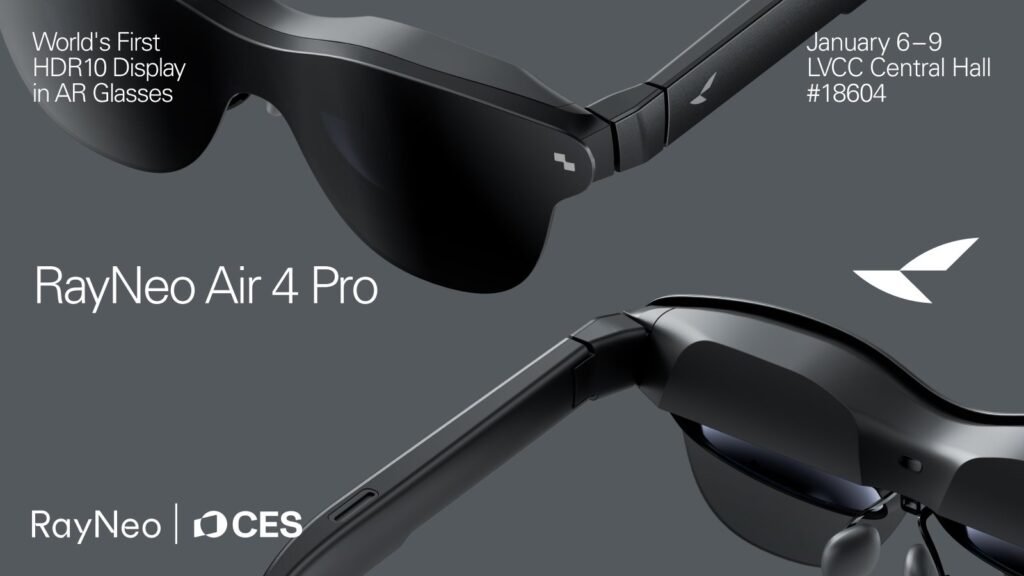
Rather than positioning the Air 4 Pro as a niche developer product, TCL is clearly targeting everyday media consumption, gaming, and productivity use cases.
The headline feature is the scale and quality of the virtual display.
• Delivers a 201-inch virtual screen
• Simulated at a 6-meter viewing distance
• Full HDR10 support for improved contrast and color depth
• Designed for movies, streaming, gaming, and extended viewing sessions
This virtual screen size places the Air 4 Pro closer to a personal cinema experience than a traditional wearable display.
Powering the visuals is TCL’s in-house processing hardware.
• Custom Vision 4000 processor
• Handles real-time image enhancement
• Optimized for low latency and consistent output
• Built specifically for wearable display workloads
The Vision 4000 chip allows the glasses to process content locally instead of relying entirely on the connected device.
TCL is also leaning heavily into visual enhancement features.
• SDR-to-HDR upscaling for older content
• Improves brightness and dynamic range on standard videos
• 2D-to-3D conversion for compatible media
• Designed to add depth without manual configuration
These features aim to make a wider range of content look better without requiring native HDR or 3D support from apps.
Audio has received equal attention.
• Quad-speaker system built into the frame
• Directional sound tubes reduce sound leakage
• Tuned in collaboration with Bang & Olufsen (B&O)
• Focus on immersive audio without headphones
The directional design is intended to keep audio private while maintaining awareness of surroundings.
Connectivity is designed to be simple and universal.
• Single USB-C connection
• Works with smartphones, laptops, tablets, and gaming consoles
• No dedicated battery required in the glasses
• Power and data delivered through the connected device
This plug-and-play approach removes the need for charging the glasses separately and keeps the overall weight down.
Key supported use cases include:
• Watching movies and TV shows on a large virtual screen
• Mobile and console gaming with a floating display
• Portable productivity setups with laptops and tablets
• Private viewing in shared environments
Because the Air 4 Pro functions as an external display rather than a standalone computer, app compatibility depends largely on the connected device.
Pricing and availability details are already confirmed.
• Priced at $299
• Positioned below many premium AR and XR headsets
• Global launch scheduled for January 25
• Availability expected across multiple regions
This pricing puts the RayNeo Air 4 Pro firmly in the consumer-accessible category rather than the experimental or enterprise tier.
TCL’s approach with the RayNeo Air 4 Pro focuses on practical improvements rather than futuristic promises.
• Emphasis on display quality over full spatial computing
• Familiar wired connectivity instead of complex wireless setups
• Enhancements aimed at real-world content consumption
By adding HDR10 support and improving processing, TCL is addressing two of the biggest limitations of earlier AR glasses: flat visuals and limited dynamic range.
The RayNeo Air 4 Pro signals a shift toward AR hardware that fits naturally into existing digital habits, without forcing users to change how they consume content.
Leave a Reply