India’s spam problem is no longer a background annoyance.
The latest 2025 Spam Shield Report from Truecaller puts hard numbers behind what most users experience daily: spam and fraud are operating at massive, industrial scale.
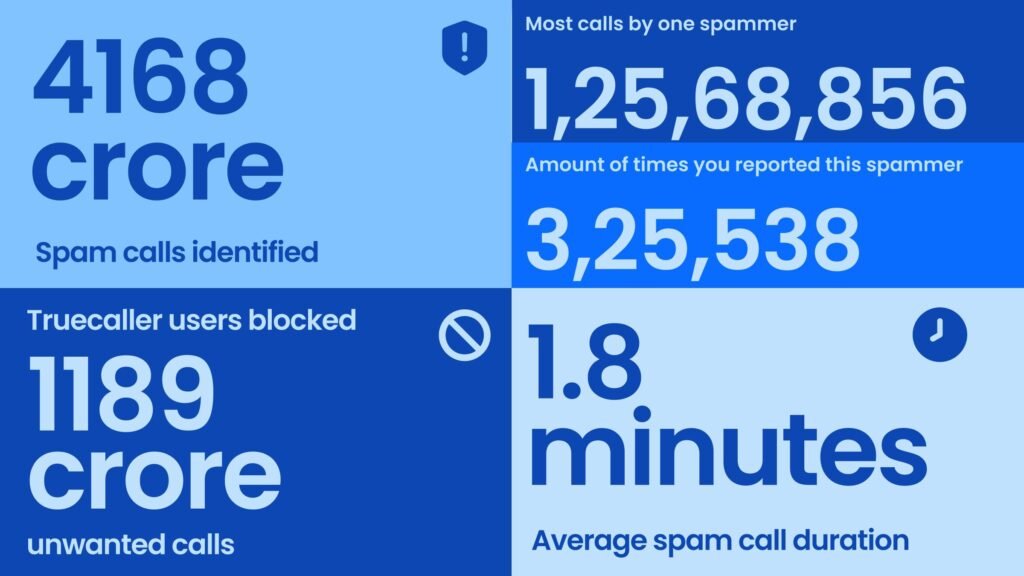
The report aggregates call and message data detected, blocked, or flagged across the country over the past year.
The result is a clear snapshot of how deep the issue runs—and why spam protection has become essential infrastructure, not a nice-to-have feature.
Key findings from the 2025 report
The scale of activity recorded in India during 2025 is staggering:
- 4,168 crore spam calls detected nationwide
- Includes calls that were blocked, labelled, or ignored
- 1,189 crore spam calls actively blocked
- Stopped before users had to engage
- 12,903 crore spam messages identified
- Covers SMS and other messaging-based spam
- 770 crore fraud calls detected
- Calls linked to financial scams, impersonation, and social engineering
These numbers reflect activity across telecom networks, devices, and user-reported data.
Why these numbers matter
Spam is no longer just telemarketing.
The data shows a clear shift toward more dangerous patterns:
- Financial fraud posing as banks, delivery services, or government offices
- Impersonation calls using spoofed or rotating numbers
- High-volume automated calling systems targeting millions of users
Fraud calls, in particular, are growing faster than traditional spam.
The 770 crore fraud calls detected in a single year highlight how aggressively scammers are targeting Indian users, especially first-time internet users and older demographics.
🚀 Need a Shopify Store That Converts?
I build fast, clean Shopify stores for DTC brands that want more sales, not just a pretty site.
Community-driven blocking at scale
One of the most important takeaways is how much of the protection now depends on collective action.
The 1,189 crore spam calls blocked figure represents:
- User reports feeding real-time databases
- Automatic call filtering based on reputation scoring
- Pattern detection across billions of calls
In simple terms, spam defence is becoming crowd-powered.
Every report improves detection accuracy for everyone else.
Messages are now a bigger problem than calls
The report also shows a major shift toward messaging-based spam:
- Over 12,900 crore spam messages flagged in one year
- Includes phishing links, fake offers, OTP scams, and impersonation texts
Messaging spam is harder to detect because:
- It doesn’t interrupt users immediately
- Links are often clicked before suspicion kicks in
- Fraudsters reuse templates across platforms
This makes automated detection and labelling critical.
What users gain from this data
For everyday users, the value is practical and immediate:
- Fewer scam calls reaching your phone
- Clear labels before answering unknown numbers
- Reduced exposure to phishing and financial fraud
- Better awareness of evolving scam patterns
For businesses and developers, the data highlights:
- The need for stronger caller authentication
- Why trust signals and verified IDs matter
- How spam undermines digital adoption at scale
The bigger picture
India is adding new internet users faster than almost any other country.
That growth also attracts bad actors.
The 2025 Spam Shield Report shows that spam prevention is now part of digital safety infrastructure, alongside payments security and identity verification.
As spam volumes grow, tools that detect, label, and block at scale are no longer optional.
They are foundational.
Leave a Reply