India’s AI ecosystem just delivered a result that’s hard to ignore. A locally built model has outperformed some of the biggest global AI systems on benchmarks that matter in everyday Indian use cases — and the data backs it up.
India’s AI ecosystem just delivered a result that’s hard to ignore. A locally built model has outperformed some of the biggest global AI systems on benchmarks that matter in everyday Indian use cases — and the data backs it up.
Here’s what stands out.
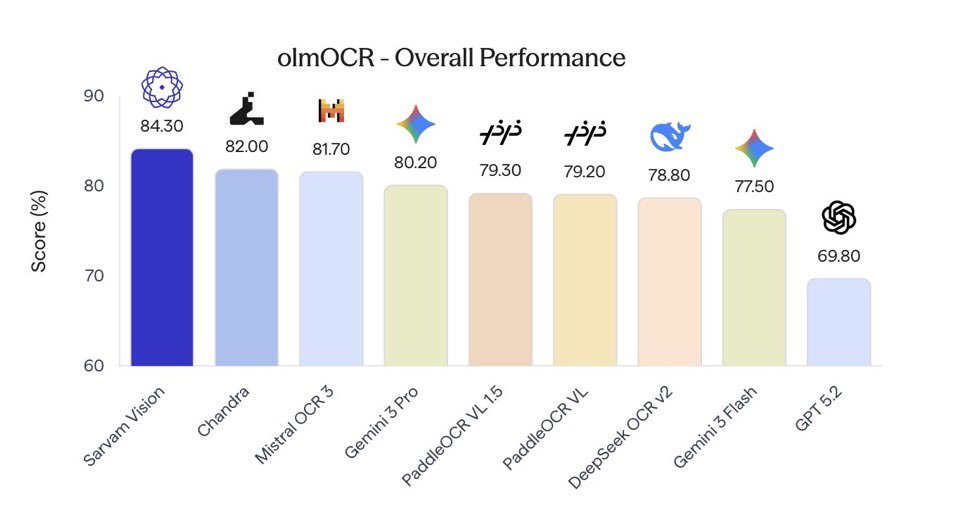
Sarvam Vision recorded 84.3% accuracy on the olmOCR Bench, a competitive evaluation designed to test optical character recognition across difficult document types.
- Outperformed major global models on this benchmark
- Delivered especially strong results on:
- Indian scripts
- Multilingual documents
- Non-standard layouts often found in government and business paperwork
This matters because most OCR systems struggle once documents move beyond clean English text. Indian documents frequently include mixed languages, inconsistent formatting, stamps, tables, and handwritten elements.
Sarvam Vision recorded 84.3% accuracy on the olmOCR Bench, a competitive evaluation designed to test optical character recognition across difficult document types.
- Outperformed major global models on this benchmark
- Delivered especially strong results on:
- Indian scripts
- Multilingual documents
- Non-standard layouts often found in government and business paperwork
This matters because most OCR systems struggle once documents move beyond clean English text. Indian documents frequently include mixed languages, inconsistent formatting, stamps, tables, and handwritten elements.
Performance improved even further on OmniDocBench v1.5, where Sarvam Vision achieved 93.28% overall accuracy.
🚀 Need a Shopify Store That Converts?
I build fast, clean Shopify stores for DTC brands that want more sales, not just a pretty site.
Key strengths observed in this evaluation:
- Reliable parsing of complex page layouts
- Accurate extraction from tables and forms
- Strong handling of mixed scripts in a single document
- Better recognition of mathematical notation and structured content
For businesses, institutions, and developers working with large volumes of scanned documents, this directly translates to fewer errors and less manual cleanup.
What makes this result notable isn’t just the scores — it’s the approach.
Sarvam’s models are trained with a local-first design philosophy:
- Deep exposure to Indian languages and scripts
- Focus on regional accents and dialects
- Training data aligned with everyday Indian documents and speech
- Optimization for multilingual and mixed-language scenarios
Global AI systems are often optimized for Western datasets and standardized formats. They perform well at scale but can struggle when context shifts. Sarvam’s results suggest that specialization can outperform generalization where local nuance matters.
What makes this result notable isn’t just the scores — it’s the approach.
Sarvam’s models are trained with a local-first design philosophy:
- Deep exposure to Indian languages and scripts
- Focus on regional accents and dialects
- Training data aligned with everyday Indian documents and speech
- Optimization for multilingual and mixed-language scenarios
Global AI systems are often optimized for Western datasets and standardized formats. They perform well at scale but can struggle when context shifts. Sarvam’s results suggest that specialization can outperform generalization where local nuance matters.
Why this matters for users and businesses:
- Faster and more accurate digitization of documents
- Better automation for government records and compliance workflows
- More reliable voice interfaces for Indian audiences
- Reduced dependency on models that aren’t optimized for local realities
For developers, it also signals an opportunity. Region-focused AI systems may deliver better outcomes than one-size-fits-all global models, especially in markets with linguistic and cultural diversity.
Leave a Reply